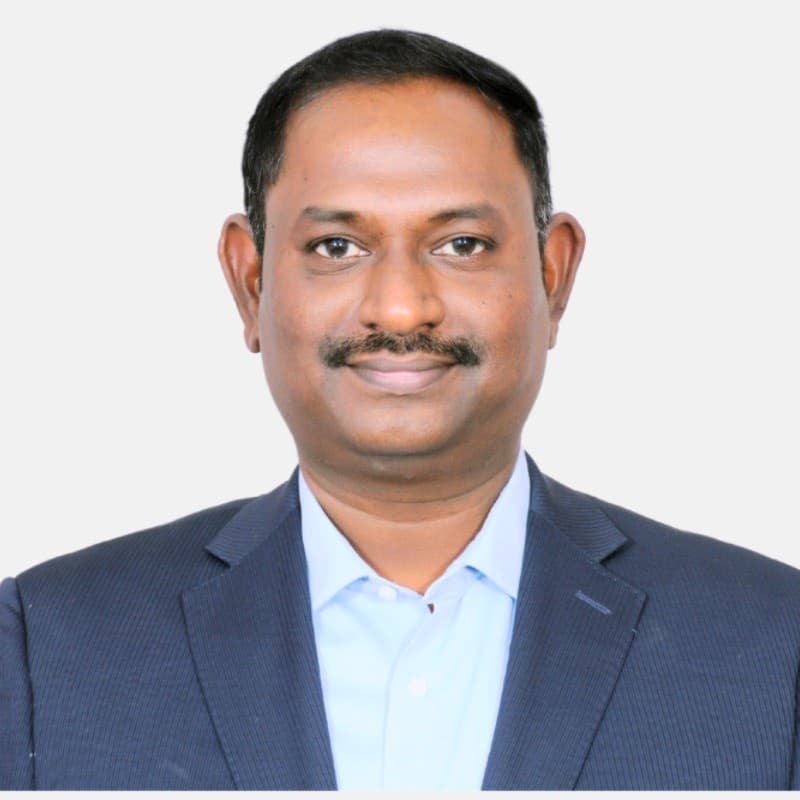
Selva Ganapathy
Principal AI Architect for Early-Stage AI Startups
Technical Strategy & Architecture from 0→1 through production scale
20 years of product engineering across Silicon Valley and India. Ex-B2B SaaS founder. I work alongside CTOs and engineering teams on AI architecture, distributed systems, production readiness, reliability, security and scale.
20 Years
Product Engineering
5 Years
Silicon Valley
+1.5 years India→US remote with the same team
Ex-SaaS Founder
0→₹6 Cr (~$700K) annual revenue
4+ Years
Production AI
50M TPM
AI Platform
SOC 2 / VAPT
Enterprise AI Security
Where I add value
Senior Architecture Depth Without Another Management Layer
Early-stage CTOs eventually reach a point where the engineering team can build, but architectural complexity begins consuming too much of the CTO's attention. I embed alongside the CTO and existing engineering team to own difficult technical problems, challenge architecture decisions, prototype where useful, and help the team move confidently into production.
AI & Agent Architecture
- RAG
- Agents
- Tool access
- Multi-model orchestration
- Evaluation
- Model adaptation
- AI reliability
- AI cost & economics
System & Platform Architecture
- Distributed systems
- Microservices
- Event-driven systems
- Multi-tenant SaaS
- Kubernetes / KEDA
- Security
- Observability
- Production readiness
Technical Strategy & Judgment
- Technical feasibility
- Build-vs-buy
- Product & technical discovery
- Architecture evolution
- High-consequence decisions
The full toolkit
AI / Agent Architecture
Model Platforms
- OpenAI
- Claude
- Amazon Bedrock
- Azure OpenAI
AI Patterns
- RAG
- Agents
- Tool Access
- Multi-model Orchestration
- Evaluation
Model Adaptation
- CoT
- Few-shot Prompting
- Fine-tuning (PEFT)
In production: Legacy AI → GenAI-first in 8 months
System Architecture
Architecture
- Microservices
- Event-driven Systems
- Distributed Systems
- Multi-tenant SaaS
Scale & Reliability
- Autoscaling (KEDA)
- Load Balancing
- Rate Limiting
- Fault Tolerance
Security & Compliance
- Tenant Isolation
- SOC 2
- VAPT
- GDPR
- Zero-data-retention design
In production: Multi-tenant AI platform at 50M TPM
Application & Data
Programming
- Python
- Flask Framework
- VueJS
Database
- MongoDB
- Pinecone
- FAISS
Agentic Engineering
- OpenAI Codex
- Claude Code
- Reusable agent skills
In production: AI quality & economics — 60%→85%, 5× cost
Platform & Operations
Cloud Platforms
- AWS (Bedrock, EKS, Textract)
- Azure OpenAI
Observability
- OpenTelemetry
- Grafana
- Loki
- Tempo
In production: Enterprise AI security & reliability
How I work
I Work Inside Your Engineering Context
I don't provide an outsourced development team. I work directly with your CTO, technical founder and engineers as a senior technical IC. Your team continues to own product development. I bring architecture depth, independent technical judgment and hands-on problem solving where the technical stakes are highest — using agentic engineering practices (Claude Code, reusable agent skills) that let one senior person deliver what used to take a team.
Embedded Principal Architect
- Works with the CTO
- Works with your existing engineers
- Architecture ownership
- Technical reviews
- Prototypes & spikes
- High-impact decisions
- Team keeps delivery ownership
Not an Outsourced Dev Shop
- No offshore dev team
- No end-to-end project handoff
- No staffing bench
- No “we build your MVP”
The engagements I find most effective are remote collaborations with funded early-stage startups where a CTO or technical founder already owns the technology function.
Selected production AI work
Four Problems, Taken to Production
From a pre-Series A B2B AI startup. Every number below is as measured — nothing rounded up.
Legacy AI → GenAI-First Platform in 8 Months
Pre-Series A B2B AI startup · 14-member engineering team
- full transition
- 8 months
- delivery freeze
- 0
Legacy AI → GenAI-First Platform in 8 Months
Pre-Series A B2B AI startup · 14-member engineering team
Context
A pre-Series A B2B AI startup with a legacy AI product that needed to become GenAI-first — without pausing the roadmap the business depended on.
My role
Architecture leadership alongside the CTO and CXO team, guiding a 14-member engineering team through the transition.
The work
Led the architectural migration and multi-model platform strategy (OpenAI, Claude, managed platforms) — build-vs-buy calls on capability, reliability, cost and vendor dependency — while securing CXO alignment at each stage.
Outcome
GenAI-first transition completed in 8 months with the existing team — no rewrite pause, no delivery freeze.
Scaling a Multi-Tenant AI Platform to 50M TPM
Model quotas, tenant fairness, bursty enterprise workloads
- tokens per minute
- 50M
- quota utilization
- 90%
- API request success
- 99%
Scaling a Multi-Tenant AI Platform to 50M TPM
Model quotas, tenant fairness, bursty enterprise workloads
The problem
Model API quotas, tenant fairness, bursty workloads and production reliability — the constraints that decide whether a multi-tenant AI product survives real enterprise traffic.
The architecture
Azure OpenAI endpoint pooling, tenant-aware quotas, rate limiting, autoscaling and failure handling, designed so no single tenant could starve the rest.
Outcome
50M tokens per minute in production, at 90% quota utilization and 99% API request success.
AI Quality & Economics
Accuracy and unit economics of production LLM features
- accuracy
- 60%→85%
- LLM cost reduction
- 5×
AI Quality & Economics
Accuracy and unit economics of production LLM features
The problem
AI features that are impressive in a demo but wrong too often — and too expensive per request — don't survive contact with paying customers.
The work
Improved answer quality through CoT and few-shot prompting, fine-tuning, response validation and evaluation pipelines. Attacked cost with batching, chunk de-duplication and multimodal routing.
Outcome
Accuracy improved from 60% to 85%, and LLM cost came down 5× — keeping AI features margin-positive.
Enterprise AI Security & Reliability
Security assurance for enterprise adoption of AI features
- reviews supported
- SOC 2 / VAPT
- MTTR
- 4h→10min
Enterprise AI Security & Reliability
Security assurance for enterprise adoption of AI features
The problem
Enterprise clients require security assurance before they adopt AI features — and an AI platform they can't observe is one they can't trust in production.
The work
Established tenant isolation, secure model access, SOC 2 and VAPT support, and GDPR plus zero-data-retention controls. Designed the observability stack on OpenTelemetry, Grafana, Loki and Tempo.
Outcome
Supported enterprise security reviews (SOC 2/VAPT) through to adoption, and brought MTTR down from 4 hours to 10 minutes.
Founder perspective
I've Sat on the Founder's Side of the Table
I co-founded and scaled a bootstrapped B2B logistics SaaS from 0→₹6 Cr (~$700K) annual revenue, growing engineering from the first hires to 30. That taught me — expensively — that early-stage engineering is less about building more and more about making the right decisions: scope, feasibility, build-vs-buy, architecture, when to scale.
Manual validation before building
Validated the 3PL problem by delivering cross-carrier tracking manually before building; the findings reshaped the roadmap.
MVP scoped to one complete journey
Booking → allocation → tracking → POD, keeping invoicing manual for eight months.
Build-vs-buy across the product
Built the differentiating allocation and tracking workflows; bought commodity OCR and managed cloud.
Proof at scale
Scaled the platform to 1M shipments/month at 99.9% uptime.
Experience
Twenty Years, Four Chapters
2021 – Present
Principal Technical Architect · Mintmesh
Bengaluru, India
Architecture leadership with the CTO for a 14-member team building a production AI SaaS platform.
2016 – 2021
Co-Founder & CEO · Naanal Technologies
Chennai, India
Bootstrapped B2B logistics SaaS from 0→₹6 Cr (~$700K) annual revenue.
2010 – 2016
Staff Software Engineer · Brocade Communications
San Jose, CA, USA
Software load balancer on Intel DPDK — performance from 1 Gbps to 160 Gbps.
2005 – 2008
Member Technical Staff · HCL Technologies
Chennai, India
Network security modules for Juniper's mobile backhaul router.
US / remote credibility
Built for Distributed, US-Facing Work
5 years onsite in Silicon Valley, then 1.5 years working remotely from India with the same US team — reporting to US-based leadership across India–US time zones. Distributed-by-default is a mode I've operated in since before it was fashionable.
Bengaluru, India · working across US/EU time zones
The knowledge brand
Author of Startup Engineering
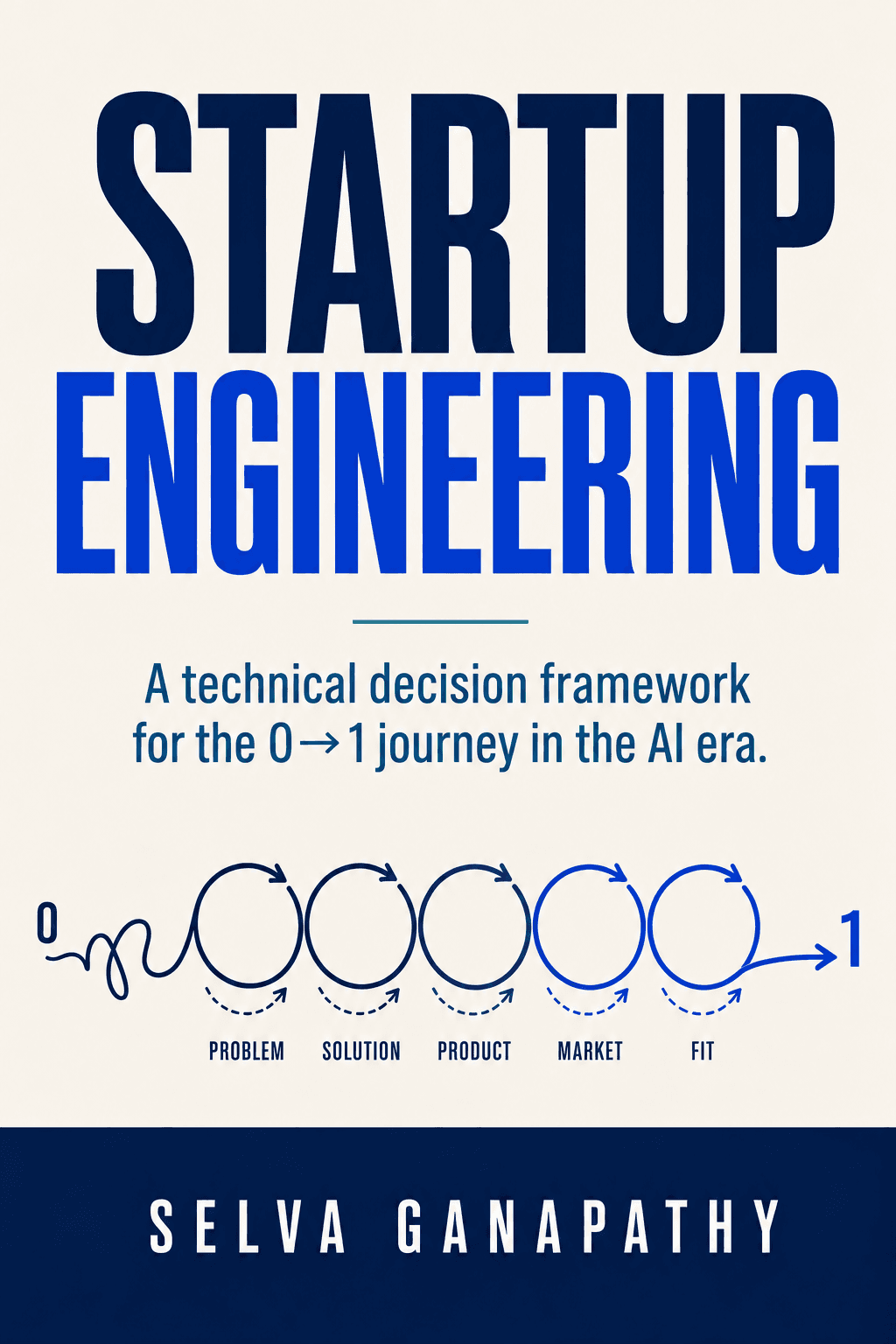
Startup Engineering is a technical decision framework for the 0→1 journey in the AI era (forthcoming). Explore the book, framework, free decision guides, newsletter and agent skill.
About
The Short Version
I'm a Principal AI Architect with 20 years of product engineering experience across Silicon Valley and India. My career spans deep systems engineering at Brocade, founding and scaling a B2B SaaS company, and architecting production AI products at an early-stage startup. I enjoy ambiguous, high-impact technical problems where architecture, product judgment and hands-on engineering intersect.
- M.S. Computer Engineering, North Carolina State University
- B.E. ECE, Government College of Technology, Coimbatore
- Indian Patent No. 202915 — Life Saving Cell Phone System
- LinkedIn Top AI Voice community badge (Aug–Dec 2024)
- 10+ workshops and webinars on AI and startup engineering
Have an Architecture Problem Worth Solving?
If you’re a CTO or technical founder building an early-stage AI product and need additional senior architecture depth, I’d be happy to understand what you’re working through.
The best way to reach me is on LinkedIn.
Or email: selvaganapathyc@gmail.com